
10-Day Water Fast 2026: Results, What Changed From Last Year, and Key Learnings
I've done multiple extended fasts – 7, 9, and 10 days, and this was my second 10-day fast after last year's 10-day fast. Same protocol, same goals, same summer timing. But the experience was measurably different. This post covers the data, the daily reality, and what actually changes when you've done this enough times to know what you're doing.
I'll share my glucose, ketones, weight, and body composition results, compare them to last year, and cover what it felt like to track this fast entirely inside my own app for the first time - as well as in an Excel file.
🎯 Why I Did It Again
My personal protocol is one extended fast per year – a full reset – combined with intermittent fasting on a daily basis. The annual extended fast isn't about weight. I'm quite lean – 160 lbs at 6'1". It's about the metabolic and cellular benefits that only accumulate over multiple days: deep ketosis, autophagy, insulin suppression, immune renewal. Things that a 16-hour window simply doesn't reach.
This year's fast ran from July 27 to August 5, 2026 – 10 days, 2 hours, and 24 minutes, tracked in the Fasting Center app. Same approach as last year: keep daily life as normal as possible, make fasting the background rather than the main event, stay active, accomplish cool things (I have a lot of spare time during extended fasts), manage electrolytes carefully – this time much more carefully.
The goal going in was the same as always – refine the habits based on the previous fast data and increase my productivity, with the goal of reaching the same level of output as during non-fasting days.
📱 The App vs Excel
Last year I tracked everything in Excel – glucose readings, ketone measurements, weight, sleep scores, notes from each day. It worked, but it was cumbersome. The Fasting Center app launched on iOS just before this fast, so I ran both in parallel – the app for real-time tracking and the old Excel for backup.
By the end of the fast, I had implemented all the features I needed to make the app the only tracking tool going forward. The side-by-side test confirmed what I suspected – having glucose, ketones, weight, and the fasting timer in one place, visible in real time, changes how the fast feels. You can see the arc of the entire fast at a glance, which makes each reading more meaningful in context. And connecting the app to HealthKit to pull readings directly, instead of typing into Excel, saves quite some time. The Google Play Store approved the Android version on day 4 of the fast, which gave me an unexpected energy boost mid-fast. Good timing!
🔬 What the Numbers Look Like
Weight
Started at 161.6 lbs, reached a low of 149.7 lbs at the very end of the fast – a total drop of 11.9 lbs over 10 days. Weight climbed back during refeeding as glycogen, water, and food volume returned, stabilizing in the 158-159 lb range by two weeks post-fast. The pattern is nearly identical to last year.
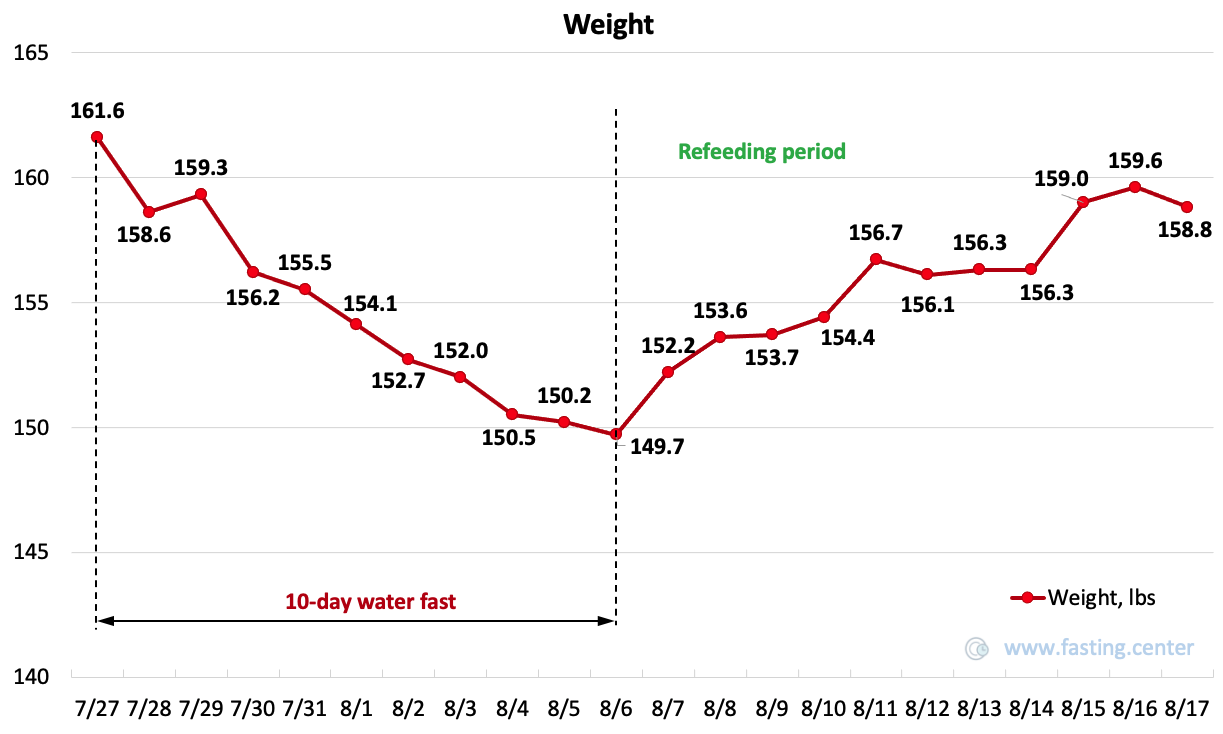
Weight across the 10-day fast and refeeding period
Body Composition
Dexa scans before, right after the fast and after refeeding provided additional interesting details on body fat and lean mass

Dexa results before the fast, right after, and 12 days into refeeding
Fat loss was 5.2 lbs during the fast, with 0.7 lb regained during refeeding. Body fat percentage went from 14.8% pre-fast to 12.2% post-refeed – a net improvement that outlasted the fast itself. I found it pretty entertaining that during refeeding the weight goes up, but at the same time body fat percentage goes down. The math is simple: the weight coming back is almost entirely lean mass – water, glycogen, and muscle – so the fat share of total weight keeps shrinking even as the scale climbs. Lean tissue dropped quite a lot – 8 lbs – during the fast, predominantly water and glycogen as expected. Surprisingly, lean mass fully came back and even brought an extra 1.3 lbs during refeeding.
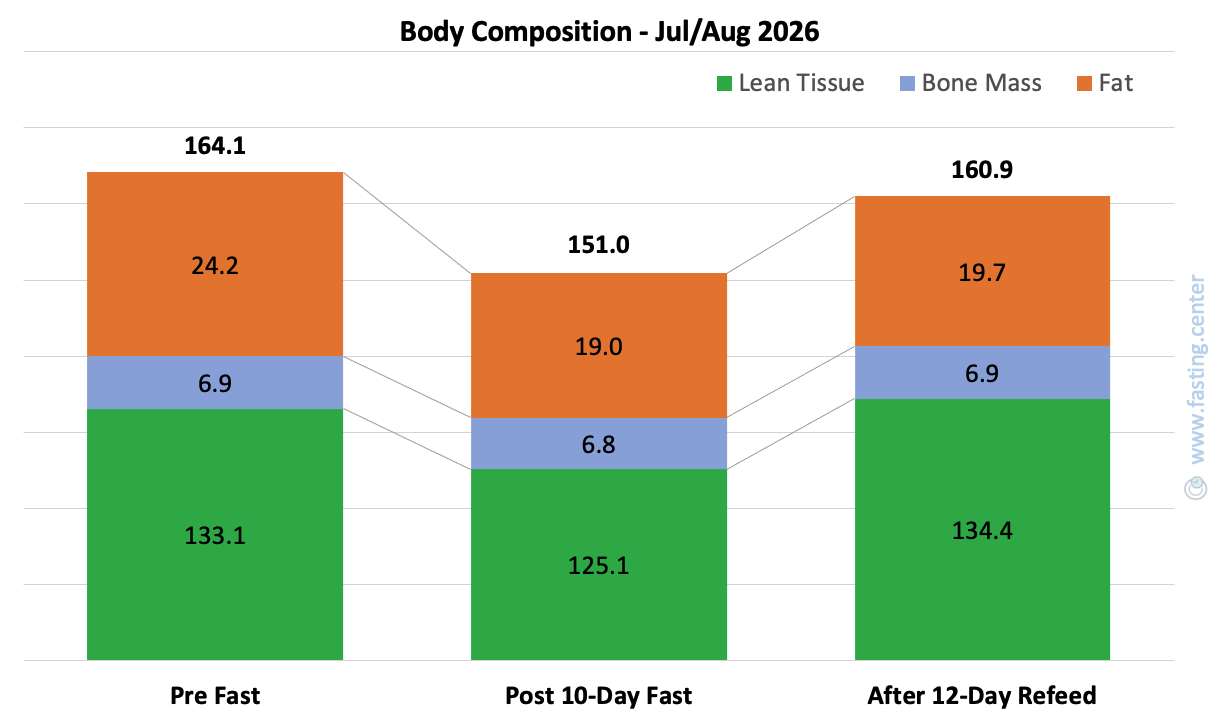
Body composition before the fast, right after, and 12 days into refeeding
Ketones: Deep and Fast
Ketones started at 0.4 mmol/L and climbed to a peak of 7.9 mmol/L. What was different from last year was the speed of the climb. In the 2025 fast, ketones reached the 5 mmol/L range around day 5. This year, staying active in the early days – gym sessions on days 1, 2, 3, 5, and 6 – depleted glycogen faster and pushed the metabolic switch earlier. By day 3 I was already at 3.2–3.4 mmol/L, well into meaningful ketosis, and crossed 5 mmol/L by day 4.
Ketones across the 10-day fast and refeeding period
The chart below puts this fast in a longer context. I've now done four well-documented extended fasts over three years, and tracking ketones across all of them reveals a consistent pattern – the metabolic response is remarkably stable from fast to fast. Peak levels, the general shape of the climb, and the refeeding drop all land in roughly the same range regardless of the fast. What the comparison also shows is that my body has developed a reliable and predictable ketone response – each fast following a similar arc, which itself is a sign of a well-trained metabolism.
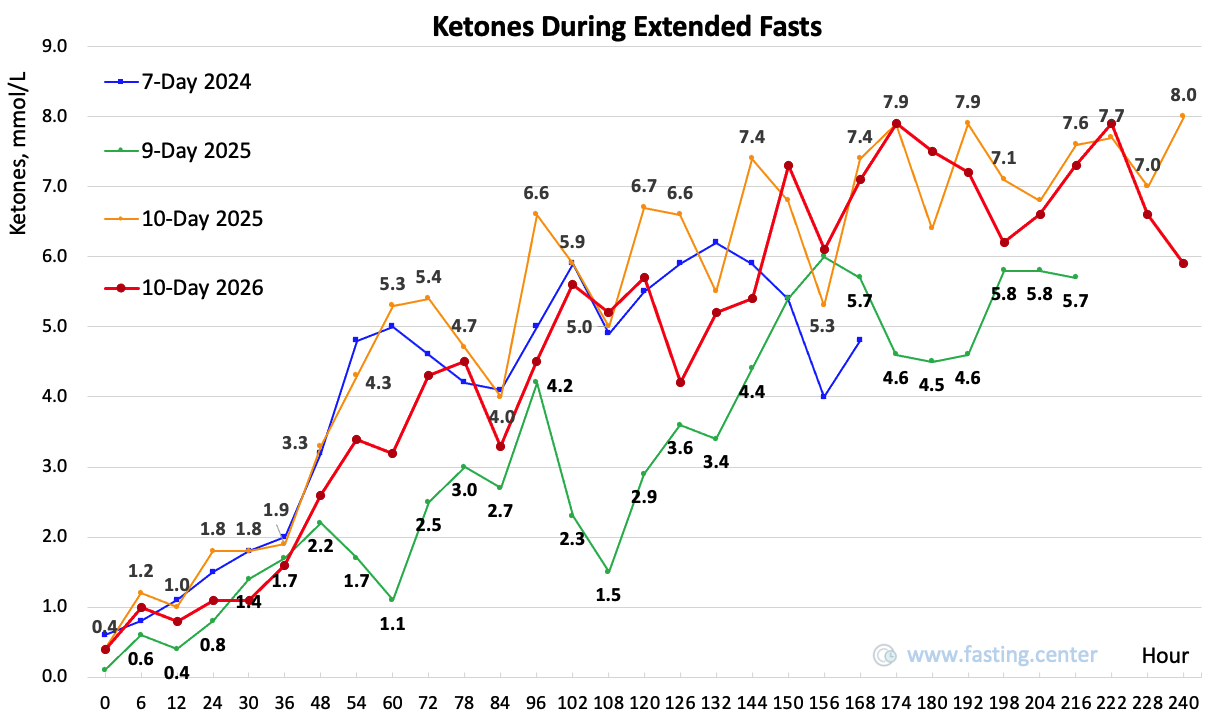
Ketone levels compared across four extended fasts: 7-day 2024, 9-day 2025, 10-day 2025, and 10-day 2026
Glucose: A Steady Drop, Then a Plateau
Glucose started at 84 mg/dL on day 1 and trended steadily downward as the fast progressed, settling into the 60–70 mg/dL range through the middle days – the same stable plateau seen in last year's fast. The low point came on day 8 when glucose briefly touched 54 mg/dL in the evening after my intense gym workout. There was also a notable mid-fast spike to 103 mg/dL after an intense gym session on day 6, which reflects the liver releasing glucose in response to exercise stress – a normal and expected response. After refeeding, glucose bounced back above 130 before settling toward baseline. The overall pattern mirrors last year closely. For a deeper look at why glucose drops and what the numbers mean, see Blood Sugar During Fasting: Why It Drops to the 60s (and Even the 40s).
Blood glucose across the 10-day fast and refeeding period
Sleep, HRV and Heart Rate
Readiness scores stayed solid throughout – mostly in the 75–89 range – which reflects how physically well-managed the fast was. Sleep scores were more variable, dipping to 58 on day 7 (the hardest day by every measure) and climbing back to 78 on day 8 after a better night. Resting heart rate stayed in the low-to-mid 40s through most of the fast. HRV was more erratic, with a notable spike to 48 on day 10 before falling post-refeed as the body shifted back into a fed state.
Sleep and readiness scores across the 10-day fast
Resting heart rate and HRV across the 10-day fast
Respiratory Rate
Respiratory rate held steady at 13.0–13.1 breaths per minute through most of the fast – slightly below the pre-fast reading of 13.8. A small, consistent drop that reflects the metabolic efficiency of running on fat and ketones rather than glucose.
Respiratory rate across the 10-day fast
📅 Year-Over-Year Comparison
Key metrics compared: 2025 vs 2026 10-day fasts
The metabolic data is nearly identical year-over-year – peak ketones, glucose floor, fat loss, heart rate all land in essentially the same range. What changed was everything else – how it felt day to day, how much mental bandwidth it consumed, and how smoothly the refeeding went.
🗓 How It Felt: Daily Highlights
Days 1–3: Smooth Start
Day 1 was easy. Last meal was coffee with cream, then a Dexa scan and full blood panel in the morning to establish the baseline. Then I went straight to the gym – 25 minutes of cycling, 5 minutes running, 20 minutes steam room. It’s the same glycogen-depleting strategy that worked last year to accelerate the ketone climb. No hunger at all. Energy was low but similar to pre-fast levels. The body stiffness I'd been carrying in my lower back essentially disappeared by the end of day 1 – it felt like high pressure in the system had been released. I had a good 40-minute nap in the afternoon. I also decided on day 1 to enhance my electrolyte mix with standalone potassium.
Day 2 brought minor calf cramps. I don't like black coffee, so I couldn't drink that much of it during the fast. Went to the gym – 10 minutes cycling, 40 minutes strength training, 20 minutes steam room. Felt great in the afternoon, probably because of the electrolytes. Cycled with my son for 50 minutes in the evening.
Day 3: small morning bowel movement, light calf cramps. Went to the gym – 10 minutes cycling, 30 minutes running (2.8 miles), 20 minutes steam room. Hunger, energy and motivation were all manageable. The biggest thing that bothered me wasn't food abstinence – it was a feeling of being limited in some way – certain options weren't available, not that I was desperate for any of them. One interesting observation – if I feel low energy during a fast, nothing can help, except, counterintuitively, going to the gym. It starts slowly, but by the end of the workout I'm full of energy!
During my extended fasts, I try to go to the gym almost every day, but the intensity goes down quite a lot – 90% on day 1, 70% on day 2, and 50% on day 3 and later. My rule is simple – don't push myself during extended fasts.
Electrolytes were one of the most actively managed parts of this fast, and I learned three distinct things across the 10 days. First, I tracked every dose, time, and quantity in Excel from day 1 – something I hadn't done as rigorously in previous fasts. Second, when calf cramps persisted through the early days, I increased my overall potassium and magnesium intake starting on day 5. The cramps reduced significantly in response. Third, persistent night urination led me to research timing – and on day 7 I moved all electrolyte intake to before 3 PM. Night urination returned to normal and sleep quality noticeably improved. The two tables below show the difference: day 1, when intake was still spread late into the evening, versus day 7, when everything was front-loaded and totals were higher.
Electrolyte intake on Day 1 vs Day 7
Days 4–7: The Grind and an Unexpected Win
Day 4 started with some nightmares — I was saving my grandmother, who passed away 25 years ago, after she got locked in an apartment across the city. Then came an unexpected energy surge: the Google Play Store approved the Fasting Center Android app. I worked on the app all day and essentially forgot I was fasting. That's the clearest demonstration of the "background noise" principle – when you have something genuinely engaging to work on, fasting stops being the dominant experience of the day. Cycled for 35 minutes at the end of the day.
Day 5: sleep was quieter and less disturbed. Worked through the entire day. At some point I realized my state would have been the same whether I was fasting or not. Full gym session: 35 minutes cycling, 30 minutes light strength training, 20 minutes steam room. Cooking Italian pasta and meatballs with my daughter in the evening was a stretch – the smell and proximity of food while not eating it is its own kind of test – but I couldn't say no to the time with her.
Day 6: cramps on my calves, even with increased electrolyte intake. Gym: 10 minutes cycling, 40 minutes light strength training, 15 minutes steam room. Worked the entire day. That night I had increased night urination, did some research, and realized I needed to move all electrolyte intake to the first part of the day instead of spreading it evenly.
Day 7: started taking electrolytes right after waking up and finished by 3 PM. Small bowel movement. Started building plans for after the fast – all as before, plus a new enhanced plan of building muscle. Had itchy eyes, used eye lubricant and it improved quite a lot. No gym – took it easy, a lot of chores at home.
Days 8–10: Low Energy, High Ketones
Day 8: great night sleep. Still a bit itchy eyes but skipped the eye lubricant. Light calf cramps. Felt really well in the morning. Went to the gym: 10 minutes cycling, 30 minutes running, 20 minutes steam room. Felt sluggish and weak in the evening. Blood sugar went down to 56 – not ideal after a hard gym session that late in the fast.
Day 9: sleep was okay, though thinking about the blood sugar of 56 negatively impacted it. Felt well during the day. Small bowel movement. Light biking for 45 minutes. Easy day, worked on my things.
Day 10: small bowel movement. Slow day, no workouts, doing my things. A key observation crystallized: fasting forces you into a quite narrow energy range. No lows like the kind of exhaustion I used to feel driving home from the office – but also no highs, no explosive exercises, no energy peaks. And when I pushed myself too much in the gym earlier in the fast, trying to go outside that range, I felt quite bad for the rest of the day. By midday while working on my project, I realized again that my state would have been essentially the same whether I was fasting or not. The fast had become invisible.
Refeeding: The Smoothest Yet
Day 1 of refeeding: Dexa scan, blood panel, and all measurements in the morning. Broke the fast the classic way – bone broth and broccoli. Hunger was surprisingly mild. The stomach was like "oh, it's time to eat, good, whatever, let's do that." No gym – instead, walked all the local coffee shops I'd been avoiding for 10 days.
Day 2: woke up around 4 AM, excited to get back to my morning routine including coffee with cream. First real bowel movement – 5 stars across every single category of evaluation (if such an evaluation exists). Was really hungry in the morning – the stomach finally woke up. Went to the gym: 10 minutes cycling, 40 minutes strength training, 20 minutes steam room – not pushing too hard, given what happened after last year's 10-day fast. Ate healthy during the day, even a tomato-cucumber salad with a bit of salmon in the evening. Some heaviness in the stomach, but overall felt good. Worked the entire day.
💡 What Was Different This Year
The metabolic data was nearly identical, but the experience was not. A few things stood out:
1. Less mental overhead. Last year I was still learning what this level of fasting feels like. This year I knew what was coming at each phase – the day 2 cramps, the day 3 shift, days 7-9 I should take it easy. Knowing the map makes the territory less demanding.
2. The app changed the tracking experience. Having everything in one place – the timer, glucose, ketones, weight, readiness scores – meant I spent less time assembling data and more time understanding and analyzing it in real time. By the end of the fast, the Excel backup was basically redundant.
3. Fasting became background noise faster. On day 4 of my first long fast, I was managing the fast. On day 4 this year, I was building new features in my app like 8 hours a day and forgot to think about it. That shift is one of the most underrated benefits of building a consistent fasting practice.
4. The refeed was easier. Each refeed has been smoother than the last. The digestive system knows the pattern now. Coming out of 10 days without food no longer requires careful monitoring – it's become a practiced transition.
5. Electrolyte management became more precise, not a best effort thing. Last year I supplemented electrolytes loosely. This year I tracked every dose and timing in Excel from day 1, increased intake on day 5 when cramps persisted, and shifted everything to before 3 PM on day 7 when night urination was disrupting sleep. Each adjustment produced a measurable result. It's the area that improved most between the two fasts.
6. Deep sleep didn't happen this year. In the 2025 fast, deep sleep was one of the most unexpected and pleasant surprises – consistently phenomenal across multiple nights. This year it simply wasn't there. Sleep scores were decent and readiness stayed solid, but the deep sleep quality was missing. The summer heat, more demanding activity schedule, or electrolyte timing could all be factors. Something to pay closer attention to in the next fast.
📝 Bottom Line
The data from this fast and last year's are nearly interchangeable. Peak ketones, glucose floor, fat loss, heart rate – all within a margin of error of each other. What's not interchangeable is everything around the data: the mental experience, the day-to-day difficulty, the refeeding, the recovery.
Extended fasting is a skill. The metabolic outcome stabilizes quickly – your body knows how to do a 10-day fast after the first one. What keeps improving is everything else. The ability to stay productive, to manage the hard days without catastrophizing, to refeed cleanly, to carry the metabolic benefits forward into daily life.
My plan going forward is to follow the same protocol – one extended fast per year, daily intermittent fasting, and a new focus on building muscle in between. And next year, no Excel.
If you want to track your own fasts the same way – glucose, ketones, weight, body fat, and a live timeline all in one place – the Fasting Center app is available on iOS and Android. Everything I used during this fast, built and refined over 10 days of actually using it.
Key metrics tracked in real time during the fast in the Fasting Center app
⬇️ Download on the App Store ⬇️ Get it on Google Play
For the full data from last year's fast, see 10-Day Fast Results: Data, Experience, and Takeaways. For context on what's happening in the body across each phase, see the Fasting Timeline.