
Fasting Risks and Downsides: The Real Tradeoffs of Extended Fasting
Fasting isn’t magic. It works because it stresses the body. Like any stressor, it can be beneficial or harmful depending on dose, frequency, and recovery. Most fasting problems don’t come from a single extended fast. They show up when people repeat long fasts too often, stack fasting with other stressors, or ignore basic physiology.
✅ Why people still do extended fasts
Extended fasting can produce effects that are hard to achieve with shorter protocols. It consistently lowers insulin, pushes the body into deep ketosis, improves insulin sensitivity, increases metabolic flexibility, and depletes liver glycogen and liver fat. There is mechanistic support and early human evidence for increased autophagy and mitochondrial cleanup, along with commonly reported effects like appetite recalibration, reduced food reward signaling, and improved mental clarity. A full list of 43 fasting benefits is available at the Fasting Benefits page.
The same mechanisms that make extended fasting powerful are also what make it risky when used too frequently or without sufficient recovery. Extended fasting also comes with real risks. The goal of this post is not to discourage fasting, but to make the tradeoffs explicit so you can use it deliberately, manage recovery, and avoid preventable mistakes.
💧 Lean mass loss happens
Weight loss during extended fasting is not just fat. Early drops of 1 to 1.5 lbs per day include lean mass - glycogen, water, gut content, muscle protein and other lean components, while actual fat loss is typically closer to 0.3 to 0.6 lbs per day. Dexa lean mass includes water and glycogen, so much of the early lean mass loss is fluid and returns during refeeding. In my last 10-day fast, Dexa showed an 8.3 lb lean mass drop, and almost all of it - 8 lbs - returned after refeeding.
Body recomposition during 10-day fast and following 12-day refeed.
💪 Muscle protein loss
Real muscle protein loss does occur. Extended fasting is a catabolic state similar to exercise - in both cases you temporarily lose muscle protein. The difference is duration: exercise is short and followed by an anabolic rebound with food, while extended fasting is prolonged and requires full refeeding to restore protein synthesis. During refeeding, muscle protein synthesis rises, nitrogen balance becomes positive again, and much of the loss can be rebuilt with adequate protein and resistance training. Repeating long fasts without proper rebuilding can lead to accumulated contractile protein loss and strength decline.
🧬 Hormonal suppression
Extended fasting suppresses several key hormones. Testosterone often drops 20-40% during multi-day fasts. T3 thyroid hormone declines as the body lowers metabolic rate, and IGF-1 can fall 30-50%, reflecting reduced growth signaling. This response is adaptive in the short term, but repeated or poorly timed extended fasting can push temporary suppression into chronically lower hormone levels.
In my own extended fasts, I observed a clear drop in testosterone during the fast, followed by a full recovery after refeeding. I break down the lab data and timelines in detail in a separate blog post “How Extended Fasting Affects Testosterone” on this topic.
Testosterone drops during extended fasts — 131 ng/dL at the end of my 9-day fast, 495 ng/dL at the end of my 10-day fast, with a clear rebound during refeeding
🧂 Electrolyte imbalance
Electrolyte imbalance is one of the most common and dangerous fasting risks. As insulin drops during fasting, the kidneys increase sodium excretion, often by several grams per day, with losses commonly reaching 3-5 g per day early on. Without replacement, low sodium drives headaches, dizziness, weakness, fatigue, and orthostatic symptoms. Potassium handling becomes less predictable, especially with blind supplementation, and magnesium loss contributes to cramps and palpitations. Electrolytes during extended fasting are not optional, and serious complications, while uncommon, are most often linked to inadequate sodium intake or poorly managed supplementation.
During my extended fasts, I was deliberate about electrolyte management. I drank water with pink salt, used Ultima electrolytes 2-3 packets per day, and had one bottle of San Pellegrino mineral water daily. With this approach, my electrolyte levels stayed completely stable. In fact, potassium was slightly elevated at the end of my 9-day fast in February, not low.
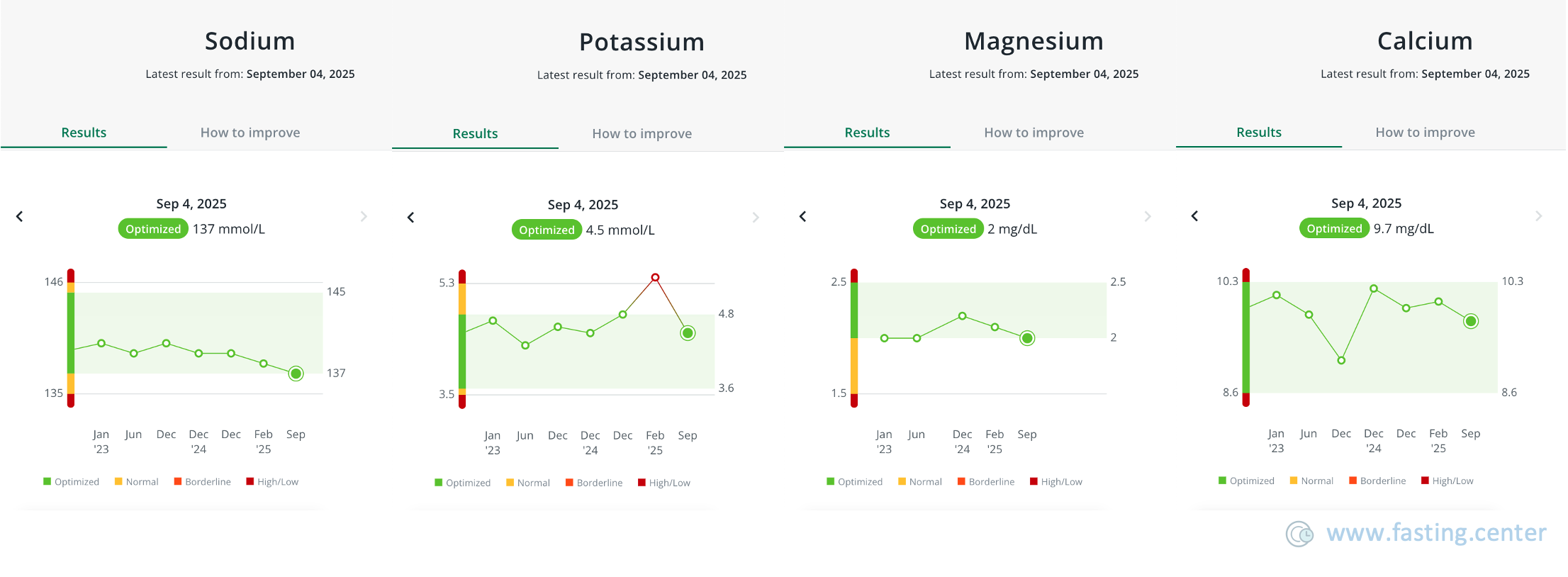
My lab panels for sodium, potassium, magnesium, and calcium
🩺 Gallbladder issues
Extended fasting increases gallbladder risk. Without dietary fat, gallbladder emptying slows and bile becomes more concentrated. Rapid fat loss increases cholesterol secretion into bile, raising the risk of sludge and gallstones. This is the same mechanism seen with very-low-calorie diets and bariatric surgery. Gallstones often form silently, with symptoms appearing weeks or months later, which is why people rarely connect gallbladder problems to a past fast.
🫀 Blood pressure instability
Blood pressure often drops during extended fasting, with systolic reductions commonly in the 5-15 mmHg range. This increases the risk of orthostatic hypotension, dizziness, and fainting, especially in lean individuals or those on blood pressure medications. Feeling lightheaded during a fast is not a sign of detox or fat burning. It is a blood pressure and sodium issue.
😴 Sleep disruption
Sleep problems are a common downside of extended fasting. Cortisol and norepinephrine rise, hunger signaling increases, and nighttime awakenings become more frequent, especially during days 2-4. Wearables may still show normal sleep duration, but deep sleep often declines. This was a real issue for me in the past, particularly during my earlier extended fasts. With experience, better electrolyte management, and pacing, this gradually improved. During my most recent fasts, sleep disruption was no longer an issue, and in some cases I actually slept better during fasting than on regular feeding days. I cover this in detail my “10-Day Fast Results: Data, Experience, and Takeaways” blog.
🧠 Psychological risks
Fasting can strengthen discipline, but it can also reinforce obsessive behavior around food, control, and restriction. Longer fasts often become performance goals rather than health tools. Binge-restrict cycles after aggressive fasting are common. Anxiety around breaking a fast is a warning sign, not willpower.
🏋️ Performance and recovery decline
Extended fasting negatively affects physical performance and recovery. Strength, power, endurance, and reaction time often decline. Low amino acid availability and suppressed mTOR signaling slow tissue repair. Training hard while fasting increases injury risk. Extended fasting does not pair well with heavy training or high workloads.
⚠️ Bottom line
Fasting works because it stresses the body. Stress without recovery causes damage. Used sparingly and intentionally, fasting can be a useful tool; used too often or too aggressively, extended fasting becomes counterproductive. And as always, extended fasting is not for everyone. It is not appropriate for pregnant or breastfeeding women, people with eating disorders, underweight individuals, or those on glucose or blood pressure medications without medical supervision.
Fasting is a powerful tool when used with awareness. Understand the benefits, respect the risks, and move forward stronger. Happy fasting!