
Hunger During Fasting: The Timeline and What Actually Drives It
Most people expect hunger to get worse the longer they fast. It doesn't. Hunger during fasting follows a predictable arc - it rises, peaks, and then for most people quietly retreats. Understanding why this happens, and when, changes how you experience every fast you do.
🧬 The hormone behind hunger: ghrelin
Hunger isn't a simple response to an empty stomach. It's primarily driven by a hormone called ghrelin, produced mainly in the stomach and duodenum. Ghrelin rises before meals and drops after eating - it's the body's primary "time to eat" signal.
What most people don't know is that ghrelin is heavily entrained to your eating schedule. If you eat breakfast at 8 am every day, ghrelin will spike around 8 am - not because your body is starving, but because it's anticipating food based on habit. This is a critical distinction. Most of what people experience as hunger during fasting is scheduled hunger - the body expecting food at its usual time - not a physiological signal that something is wrong.
This is also why the first day of a fast is often the hardest. Your ghrelin is firing on its normal schedule, sending hunger signals at all the times you'd usually eat. Once those windows pass without food, the signal fades - and the next cycle is weaker.
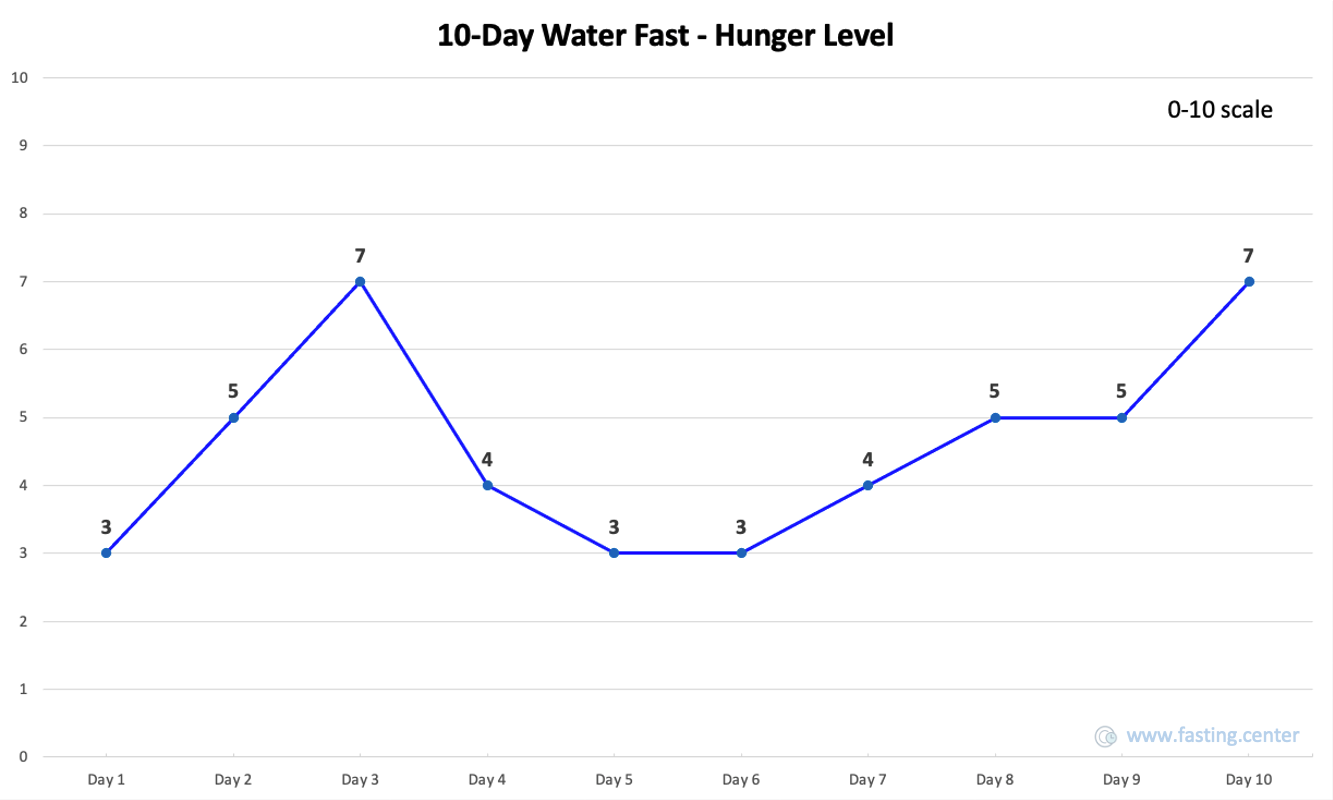
⏱ The hunger timeline, stage by stage
1. Hours 0-12: Scheduled hunger fires. This is the easiest phase for most people because it overlaps with normal waking hours and the body still has liver glycogen available. Hunger waves appear at habitual meal times but pass within 20-30 minutes if you don't act on them. Blood glucose is still relatively stable, so there's no physiological crash - just the psychological pull of habit.
2. Hours 12-24: The first real test. Liver glycogen is depleting. Blood glucose begins to drop. Ghrelin is still cycling on its normal schedule. For metabolically inflexible people, this is where the energy gap becomes noticeable - the fat-burning system hasn't fully activated yet, and the glucose supply is running low. Hunger feels more urgent here, and for some people it peaks somewhere in this window.
3. Hours 24-48: Peak hunger, then the turn. Ghrelin levels peak around day 2 of fasting. This is the most commonly reported hardest stretch of a short fast. But something important also begins here: ketone production ramps up meaningfully, and the brain starts shifting to ketones as a fuel source. As this transition takes hold, the urgency of hunger begins to ease — not because ghrelin disappears, but because the brain has fuel and the body is no longer signaling an energy emergency.
4. Days 2-3: Hunger quiets. For most people who push through the day 2 peak, something shifts. Hunger becomes less insistent - more like a background awareness than an urgent demand. Ghrelin begins to decline from its peak. Ketones are now a meaningful fuel source. Many people report that day 3 of a short fast feels surprisingly manageable compared to day 1.
5. Beyond 3 days: Extended fasting - appetite suppression deepens. During extended fasts, hunger continues to recede for most people. Ketone levels reach ranges where they actively suppress appetite — not through willpower, but through direct hormonal and neurological effects. Many experienced fasters describe days 4 and 5 of an extended fast as having almost no hunger at all. Appetite returns clearly during refeeding, which is one of the clearest signs the body is ready to eat again.
🔬 Why ketones suppress hunger
Ketones aren't just an alternative fuel - they act as signaling molecules that directly influence appetite. As blood ketone levels rise into the 2-5 mmol/L range and beyond, they interact with the hypothalamus and appetite-regulating circuits in ways that reduce the drive to eat.
This is part of why extended fasting produces a qualitatively different hunger experience than calorie restriction. Someone cutting calories is still eating - their ghrelin cycles normally, their blood sugar fluctuates with each meal, and hunger remains a constant management problem. Someone in deep ketosis during an extended fast is operating in a fundamentally different metabolic state. The hunger suppression isn't discipline - it's biochemistry.
This also explains the paradox many fasters notice: the longer the fast, the less they think about food. The first 24 hours can feel food-obsessed. By day 4 or 5, the mental preoccupation often disappears almost entirely.
🛠️ How fasting recalibrates hunger long-term
One of the most underappreciated effects of regular fasting is what it does to hunger outside of fasts. Over time, consistent fasting resets the ghrelin rhythm. People who fast regularly report that their habitual hunger signals become less urgent - they can skip a meal without the crash, delay eating without irritability, and recognize the difference between genuine hunger and scheduled habit more clearly.
This recalibration happens because ghrelin entrains to whatever eating pattern you maintain consistently. If you shift your eating window and hold it for several weeks, ghrelin adapts to the new schedule. The 8 am spike fades. A new pattern emerges - one that matches your actual eating behavior rather than your old one.
This is why people who fast consistently often describe a cleaner relationship with food. Not because they've developed iron willpower, but because the hormone that generates hunger has been retrained to a different rhythm.
⚡ What actually makes hunger worse during fasting
1. Poor sleep. Sleep deprivation elevates ghrelin and suppresses leptin - the satiety hormone - independently of fasting. A bad night's sleep going into a fast will make hunger significantly harder to manage the next day. This is one of the most controllable variables people overlook.
2. Electrolyte depletion. Many people confuse electrolyte symptoms - headache, fatigue, irritability - with hunger. Sodium, potassium, and magnesium all drop during fasting, and their depletion produces a general sense of feeling bad that the brain interprets as a need to eat. Correcting electrolytes often resolves what felt like hunger entirely.
3. Metabolic inflexibility. As covered in the metabolic flexibility post, people who struggle to switch from glucose to fat experience a genuine energy gap in the 12–24 hour window. That gap feels like intense hunger - because physiologically, it is. The fix is building fat-burning capacity over time, not white-knuckling through the gap repeatedly.
4. Boredom and habit. A significant portion of what people experience as hunger during fasting is psychological. Food is woven into daily routines - the coffee break, the lunch meeting, the evening wind-down. When those moments arrive without food, the brain sends an alert. Recognizing this pattern - and having something to do with that time - makes a real difference.
📝 Bottom Line
Hunger during fasting is not a straight line upward. It peaks - usually in the first 24 to 48 hours - and then for most people it declines, often dramatically. The mechanism is ghrelin adapting away from its habitual schedule, combined with ketones stepping in as a brain fuel that actively suppresses appetite.
The hardest part of fasting is almost always the beginning, not the end. If you can get through the day 1 to 2 window - which is largely scheduled hunger and metabolic adjustment, not genuine starvation - what follows is usually easier than most people expect. Every fast gets easier as the body learns the pattern. The hunger you feel on day 1 of your tenth fast will be noticeably different from day 1 of your first.
📚 References
Below are the key peer-reviewed papers supporting the major claims in this post, including ghrelin's role in hunger signaling, its entrainment to eating schedules, and how ghrelin changes across multi-day fasting.
"Plasma ghrelin levels and hunger scores in humans initiating meals voluntarily without time- and food-related cues" 🔗 - Foundational paper establishing ghrelin as the primary meal-initiation signal. Shows ghrelin rises before meals and is suppressed within minutes of refeeding — not water — confirming its role as a food-anticipatory hormone rather than a simple emptiness signal.
"Reciprocal changes in endogenous ghrelin and growth hormone during fasting" 🔗 - Key paper tracking ghrelin levels across 4 days of fasting in humans. Shows ghrelin peaks around day 2 then begins to decline — directly supporting the hunger timeline described in this post.
"Effects of Ramadan intermittent fasting on hormones regulating appetite in healthy individuals: A systematic review and meta-analysis" 🔗 - 2025 meta-analysis of 16 studies showing intermittent fasting significantly increases ghrelin while having no significant effect on leptin — supporting the claim that ghrelin is the dominant appetite hormone affected by fasting.