
One of the most common questions about IF - how much will I lose if I do IF for 4 weeks, 12 weeks, or 6 months? Many people measure their IF success as weight loss. Intermittent fasting does not make you lose weight. Eating less and keeping insulin low does. IF just happens to be one of the easiest ways to do both.
That difference explains why one person drops 10 pounds on 16:8 and another loses nothing for months. Here is how it works, what the trials show, and what to expect.
🕐 IF Is an Eating Pattern, Not a Diet
A diet tells you what to eat. Intermittent fasting tells you when. There is nothing in IF about food, calories, or macros. You pick a daily eating window - 8 hours for 16:8, 6 hours for 18:6, 4 hours for 20:4 - and you fast the rest of the day. That is the whole rule.
This matters for weight loss, because a pattern cannot guarantee a result. You can eat 3,500 calories of pizza inside a 6-hour window and still call it IF. Intermittent fasting helps you lose weight only to the degree that it changes two things in your body.
⚖️ The 2 Conditions for Weight Loss
We lose weight when two conditions are met.
A calorie deficit. You burn more energy than you eat. This decides whether you lose weight and how much.
Low insulin. Insulin is the storage hormone. While it is high, the body stores energy and holds fat inside fat cells. When it falls, stored fat becomes available as fuel.
The deficit creates the need for stored energy. Low insulin opens the door to it. You want both. IF can partially help with the first condition, and it definitely helps with the second.
Condition 1 - a shorter window means fewer calories. When you eat in fewer hours, you eat fewer times. One meal disappears, and so does the late-night snacking. Most people end up eating less without trying.
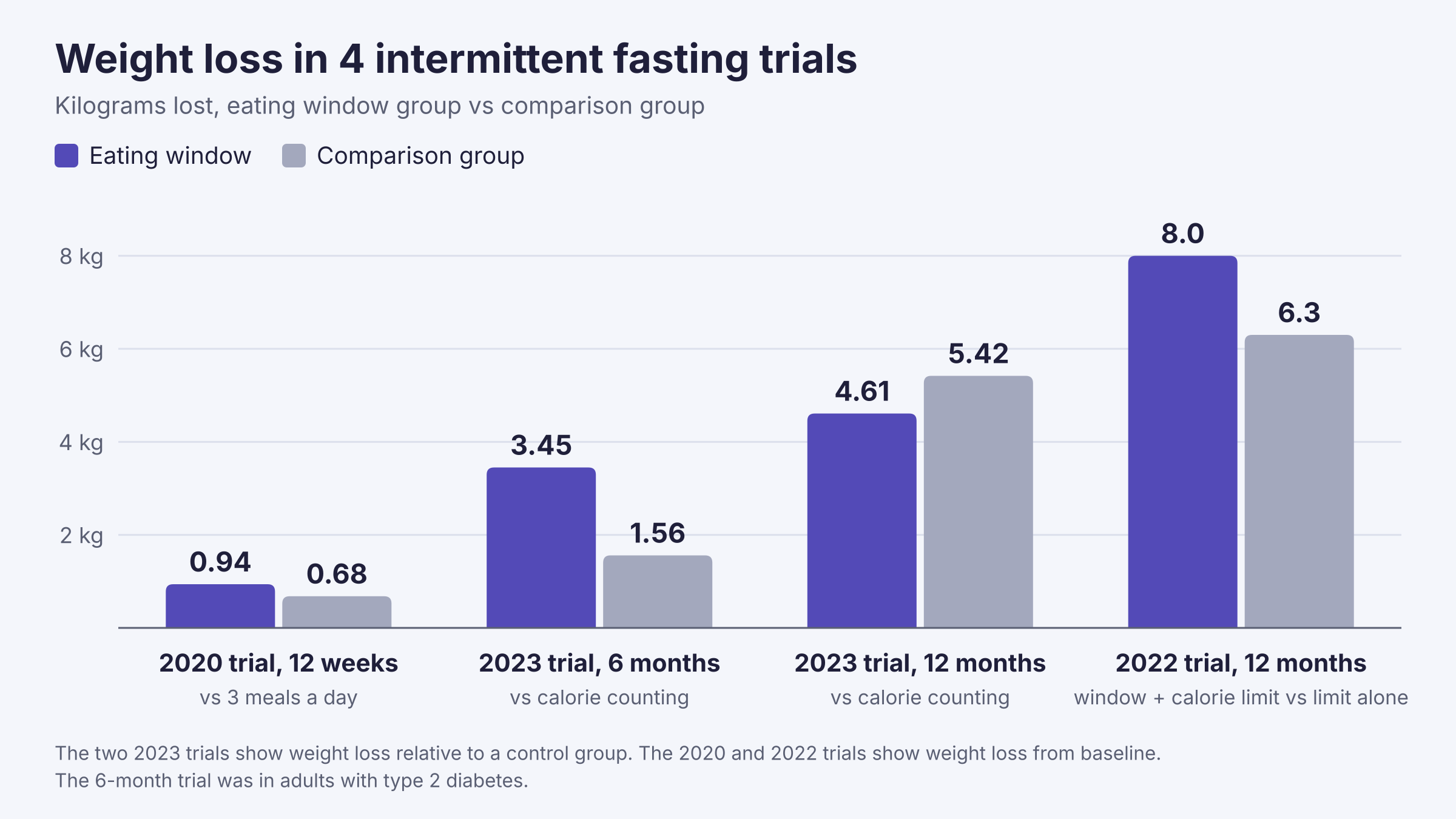
The best evidence is a 2023 trial of 75 adults with type 2 diabetes. One group ate in an 8-hour window with no calorie counting. The other group counted calories with a target of 25% less. After 6 months:
The 8-hour window group ate about 313 fewer calories per day. The calorie counting group managed 197.
The window group followed the plan on 87% of days. The counting group hit their calorie goal on 68%.
Weight loss was 3.6% with the window and 1.8% with counting.
A clock is easier to follow than a food log.
But the help is only partial, because nothing stops you from eating the same calories in less time. In a 2020 trial of 116 people, the 16:8 group ate about as much as the group eating 3 meals a day. After 12 weeks they had lost 0.94 kg, and the 3-meal group had lost 0.68 kg. No deficit, no real weight loss.
A shorter window is also not the only way to limit calories. The other common ones:
Counting calories. Precise, but hard to keep up for months.
Limiting types of food. Cutting sugar, refined carbs, or ultra-processed food, the way low-carb and keto do.
Smaller portions. The same food, just less of it.
Cutting liquid calories and snacks. Soda, juice, alcohol, and eating between meals.
IF combines well with any of them. A window plus better food choices gives a stronger deficit than either one alone.
Condition 2 - long hours of low insulin. Every time you eat, insulin rises and stays up for a few hours. An eating window gives you a long stretch every day where insulin sits at baseline and the body runs on stored fat. This is the part IF does reliably. My fasting timeline shows what happens hour by hour.
🔬 What the Trials Show - IF vs Calorie Counting
Three results give the full picture.
A 2025 analysis in The BMJ pooled 99 randomized trials and 6,582 adults. Daily eating windows reduced body weight compared with eating freely, and the result was about the same as daily calorie restriction.
A 12-month trial from 2023 put 90 adults on an 8-hour window with no calorie counting, a 25% calorie cut, or no change. Compared with the control group, the window group lost 4.6 kg and the calorie counting group lost 5.4 kg.
A 12-month trial in NEJM from 2022 gave 139 people the same calorie targets and added an 8am to 4pm window for half of them. Both groups lost weight. The difference was 1.8 kg in favor of the window, and it was not statistically significant.
So IF is not magic, and it is not worse than dieting. It matches calorie counting without the counting. That simplicity is the real advantage, because the best plan is the one you can still follow a year from now.
📊 How Much Weight to Expect, and How Fast
It depends on how aggressive the calorie deficit is. In the trials, people lost about 3 to 5% of body weight over 6 to 12 months. At 200 pounds, that is 6 to 10 pounds. That is slower than most people expect. The first week or two often look faster, but much of that early drop is water and glycogen, not fat.
Remember that these are averages across people who were given a window and little else. When both conditions are met every day, you can beat the average. When calories do not change, you get the 2020 result - under 1 kg in 12 weeks.
To see what your own numbers could look like, use the weight loss calculator. And if you are curious what longer fasts do, I covered that in Weight Loss and Fat Loss During Extended Fasting. It is a different tool with different math.
✅ Final Takeaway
Intermittent fasting is an eating pattern, not a diet. It does not guarantee weight loss. What it does is make the two conditions easier to meet. A shorter window usually means fewer calories, and a long daily fast keeps insulin low for hours. Meet both and the weight comes off, about as well as with calorie counting and with a lot less effort. Miss the deficit and the scale will not move, no matter how clean your 16 hours are.
One caution. If you take insulin or other glucose-lowering medication, are pregnant or breastfeeding, or have a history of eating disorders, talk to your doctor before you start. Medication is a different question - never adjust it on your own.
Start with a window you can keep, hold it steady, and let the two conditions do the work.
📚 References
These papers support the trial results and calorie figures in this post.
“Intermittent fasting strategies and their effects on body weight and other cardiometabolic risk factors: systematic review and network meta-analysis of randomised clinical trials” 🔗 - BMJ 2025, 99 trials and 6,582 adults. Supports the claim that IF matches daily calorie restriction for weight loss.
“Time-Restricted Eating Without Calorie Counting for Weight Loss in a Racially Diverse Population: A Randomized Controlled Trial” 🔗 - Annals of Internal Medicine 2023, 90 adults, 12 months. Supports the 4.6 kg vs 5.4 kg comparison and the 12-month expectation.
“Calorie Restriction with or without Time-Restricted Eating in Weight Loss” 🔗 - NEJM 2022, 139 patients, 12 months. Supports the claim that at equal calories a window adds no significant extra weight loss.
“Effect of Time-Restricted Eating on Weight Loss in Adults With Type 2 Diabetes: A Randomized Clinical Trial” 🔗 - JAMA Network Open 2023, 75 adults, 6 months. Supports the calorie reduction, adherence, and 3.6% vs 1.8% figures.
“Effects of Time-Restricted Eating on Weight Loss and Other Metabolic Parameters in Women and Men With Overweight and Obesity: The TREAT Randomized Clinical Trial” 🔗 - JAMA Internal Medicine 2020, 116 participants, 12 weeks. Supports the claim that 16:8 without a calorie deficit produces almost no weight loss.