
Fasting vs Exercise vs Diet: The Unique Benefits Only Extended Fasting Can Deliver
Fasting, exercise, and diet each trigger distinct biological effects. Some overlap — but many don't. Here's what each one does that the others simply can't, and why all three still need each other.
🔥 What extended fasting does
A question I hear constantly — why bother with extended fasting if you can just eat better or exercise more? Because fasting crosses metabolic thresholds that no meal or workout can replicate. These effects belong exclusively to extended fasting.
1. Deep ketosis
Normal diet produces around 0.1 mmol/L of ketones, and strict keto gets you to 0.5-2. Extended fasting pushes ketone levels to 5-8 mmol/L — a range where ketones stop being just fuel and become signaling molecules. At this depth they influence appetite, mental clarity, and cellular repair in ways that dietary ketosis simply doesn't reach.
Ketone levels across a 10-day water fast and refeeding period
2. Autophagy activation
Autophagy is the body's cellular recycling system — it dismantles damaged proteins and dysfunctional organelles and rebuilds them. Animal studies show a 5× surge after 48 hours of fasting. Neither calorie restriction nor exercise produces the same depth of mTOR suppression or the same continuous autophagy signal. Extended fasting is the most reliable way to get there. If you're interested in learning more about autophagy during extended fasts, I wrote a full breakdown here 👉 Autophagy During Fasting: What Really Happens Inside Your Cells.
3. Full gastrointestinal rest
Your digestive system activates 3-5 times a day while eating. During an extended fast, that workload drops to near zero — giving the gut lining, the enteric nervous system, and the microbiome a level of rest that no dietary approach can provide. This is one of the most underappreciated effects of longer fasts.
4. Metabolic switching
Around the 24-hour mark, liver glycogen runs out and the body makes a complete, committed shift to fat and ketones as primary fuel. This is a fundamentally different metabolic state from anything achievable through diet or exercise alone — a full systemic reset that changes how every organ in the body operates.
5. Deep insulin suppression
Insulin drops 50-70% and stays there. Blood glucose stabilizes in the 60-70 mg/dL range. The sustained depth and duration of this suppression is not achievable through carb restriction alone — it requires the complete absence of food intake. This matters because chronically elevated insulin is one of the root drivers of metabolic dysfunction. If you're interested in seeing how this plays out in real biomarker data, I tracked my gut health markers across multiple extended fasts here 👉 Gut Health Biomarkers
6. Appetite recalibration
Hunger peaks at 24-48 hours and then, for most people, quietly retreats. This creates a separation between genuine hunger and habitual eating that almost nothing else can replicate. After an extended fast, people consistently report a clearer relationship with food — knowing what real hunger feels like versus eating out of habit or boredom.
🏋️ What exercise does that nothing else can
Exercise is the single most evidence-backed intervention for longevity in medicine. Its structural effects on the body are irreplaceable — and fasting is not a substitute for any of them.
1. Muscle mass and strength
Mechanical tension from resistance training is the primary driver of muscle protein synthesis. No dietary strategy or fasting protocol builds muscle — this requires progressive overload and adequate protein. Muscle mass is one of the strongest predictors of functional longevity, and it can only be earned through consistent training.
2. VO2 max and cardiovascular fitness
Aerobic capacity adapts only through repeated cardiovascular stress. VO2 max is one of the best single predictors of all-cause mortality, and no supplement, diet, or fasting protocol improves it. Only consistent aerobic work does. This is one of the clearest cases in medicine where there is simply no shortcut.
Mortality risk relative to elite fitness group. Based on VO2 max quintile data from Mandsager et al., JAMA Network Open, 2018. Going from low to above-average fitness cuts all-cause mortality risk more than almost any other intervention.
3. Bone density
Weight-bearing mechanical load is the primary signal for bone remodeling and mineralization. Fasting cannot substitute for this — and extended fasting without adequate refeeding can actually risk bone mass over time. Exercise is the irreplaceable driver of skeletal health across a lifetime.
4. Neuroplasticity and mood
Exercise elevates BDNF (brain-derived neurotrophic factor), promotes neurogenesis, and has antidepressant effects comparable to medication in some studies. Regular physical activity reshapes the brain in ways that diet and fasting do not. The cognitive and psychological benefits of consistent movement are among the most robust findings in health research.
5. All-cause mortality reduction
The mortality data behind regular exercise is among the strongest in all of medicine. Consistent movement — even walking — dramatically reduces risk across cardiovascular disease, cancer, metabolic disease, and cognitive decline. No other single intervention has the same breadth of evidence behind it.
🥗 What diet does that nothing else can
Diet is the daily foundation everything else is built on. It's the only lever that delivers what the body actually needs to function, repair, and thrive across decades.
1. Micronutrient delivery
Vitamins, minerals, essential fatty acids, amino acids — these can only come from food. No fast or workout session provides magnesium, zinc, B12, or omega-3s. A poor diet creates deficiencies that neither fasting nor exercise can correct, and those deficiencies quietly undermine every other health effort.
2. Gut microbiome support
Dietary fiber, fermented foods, and the diversity of what you eat directly shape the composition of your gut microbiome — which influences immunity, inflammation, neurotransmitter production, and metabolic health. The microbiome is literally fed by what you eat, and fasting periods alone cannot build or sustain a healthy microbial community.
3. Long-term consistency and compounding
Diet is the lever you pull every single day. Its effects compound across years and decades in a way that periodic fasting or even regular exercise cannot fully match. Chronic inflammation and metabolic disease are built meal by meal — and they're dismantled the same way. No intervention is more quietly powerful over a lifetime than what you eat consistently.
4. Epigenetic influence
What you eat shapes gene expression through epigenetic mechanisms. Polyphenols, folate, choline, and other dietary compounds influence which genes are switched on or off — with effects that persist across years. This is one of the most active areas of nutrition research, and the picture emerging is that diet reaches deeper into our biology than we previously understood.
🔗 They complement each other — fasting is just one tool in the box
Fasting, exercise, and diet are not competing. They're three distinct levers acting on different biological systems, and the most effective health strategy uses all three intentionally.
Diet is your daily foundation — it provides what the body needs to function and sets the baseline for everything else. Exercise is your structural investment — it builds the muscle, bone, and cardiovascular capacity that carries you through decades of life. Fasting is your periodic maintenance — it triggers the deep cellular cleanup, metabolic reset, and hormonal states that diet and exercise alone don't reach.
The case for fasting isn't that it's superior. It's that it's different. The depth of ketosis, the continuous autophagy signal, the complete GI rest, the insulin suppression — these are effects with no real analogue in any diet or workout protocol. But they're most powerful when built on a foundation of good nutrition and consistent movement.
I believe extended fasting is genuinely undervalued in the mainstream conversation about health. Not because it should replace anything — but because most people don't realize it's available to them at all, and that it reaches places nothing else does. Use all three. They work better together.
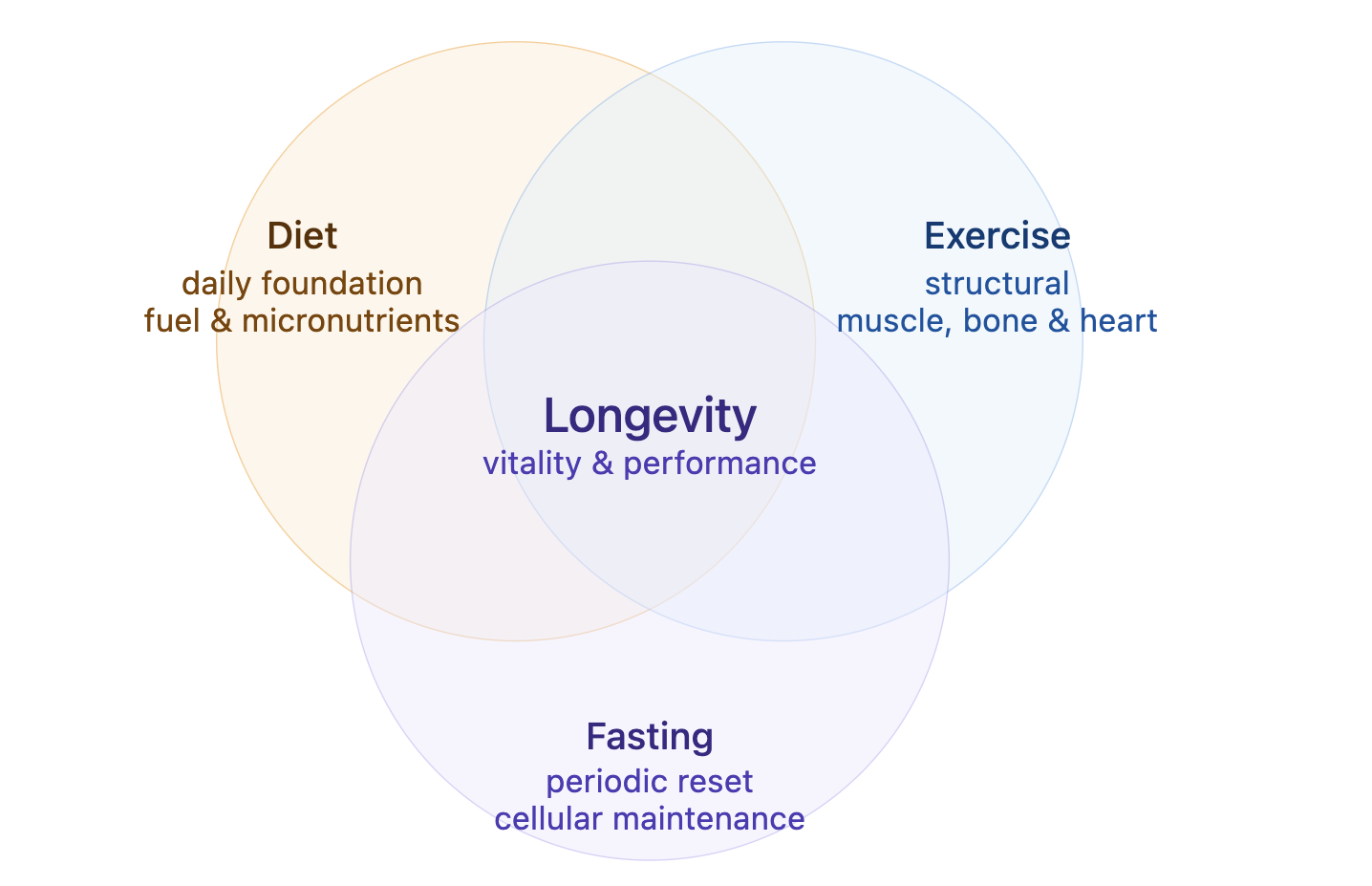
Three tools for longevity: diet, exercise, and fasting.
📝 Bottom Line
Fasting can lower inflammation, trigger autophagy, reset insulin sensitivity, and reach metabolic states that diet and exercise simply cannot. But it is only one factor. Its effects are not permanent on their own, and it is not a replacement for consistent training or quality nutrition.
Fasting is best viewed as a tool that complements everything else — one that does something genuinely unique, but works best when built on a foundation of good food and regular movement. Used together, all three are more powerful than any one of them alone. If you're new to fasting or want to build a solid foundation, start with my Complete Fasting Guide.