
Fasting benefits have become a major area of interest in health and longevity research. From intermittent fasting benefits like improved blood sugar regulation and appetite control to extended fasting benefits linked to ketosis, autophagy, and deeper metabolic adaptation, fasting affects the body on multiple levels.
Fasting is a metabolic stress that forces the body to adapt. As food intake stops, insulin drops, glycogen becomes depleted, fat oxidation increases, ketones rise, and multiple repair and stress-response pathways become more active. And these effects happen on multiple levels:
whole-body outcomes
system-level adaptations
cellular mechanisms
Not all fasting benefits have the same level of evidence though. Some are strongly supported in humans. Others are promising but still emerging. Some remain speculative. That is why it is important to separate intermittent fasting benefits, extended fasting benefits, and fasting claims that are still mostly theoretical. If you are just starting with intermittent fasting, I also put together practical intermittent fasting tips that make the process easier and more sustainable - “17 Intermittent Fasting Benefits” blog.
📚 How Strong Is the Research?
Fasting research has grown dramatically over the last several decades.
The growth in fasting research is impressive, but the quality of evidence still varies widely depending on the specific benefit being discussed. The graph above helps explain why fasting has become such an active research area across metabolism, cardiology, neurology, aging, inflammation, oncology, and cellular biology. But more studies does not mean every fasting claim is proven.
For my fasting benefits ranking, I used a weighted evidence framework where each benefit is scored across 10 dimensions:
mechanistic plausibility
human observational evidence
human RCT evidence
effect size and clinical relevance
consistency and replication
directness to the claim
measurement validity
dose-response and temporality
durability
safety and benefit-risk balance
The highest-weighted factor is human RCT evidence, followed by mechanistic plausibility and clinical relevance. That means a benefit does not rank highly just because it sounds biologically plausible. It needs measurable human evidence, consistency across studies, and a reasonable benefit-risk profile.
For example, fat loss ranks very highly because it has strong mechanistic support, extensive human observational evidence, randomized human trials, large measurable effect sizes, and highly consistent real-world outcomes across different fasting approaches.
Autophagy is different. The biological mechanisms are extremely plausible and strongly supported in animal and cellular studies, but direct measurement in humans is still difficult. That means autophagy ranks as highly promising scientifically, but with weaker direct human evidence compared to something like fat loss or insulin sensitivity.
Based on that framework, fasting benefits are grouped into three categories - “Clearly Supported by Research”, “Early-Stage Research, Promising but Still Emerging”, and “Speculative, Anecdotal, or Limited Evidence”.
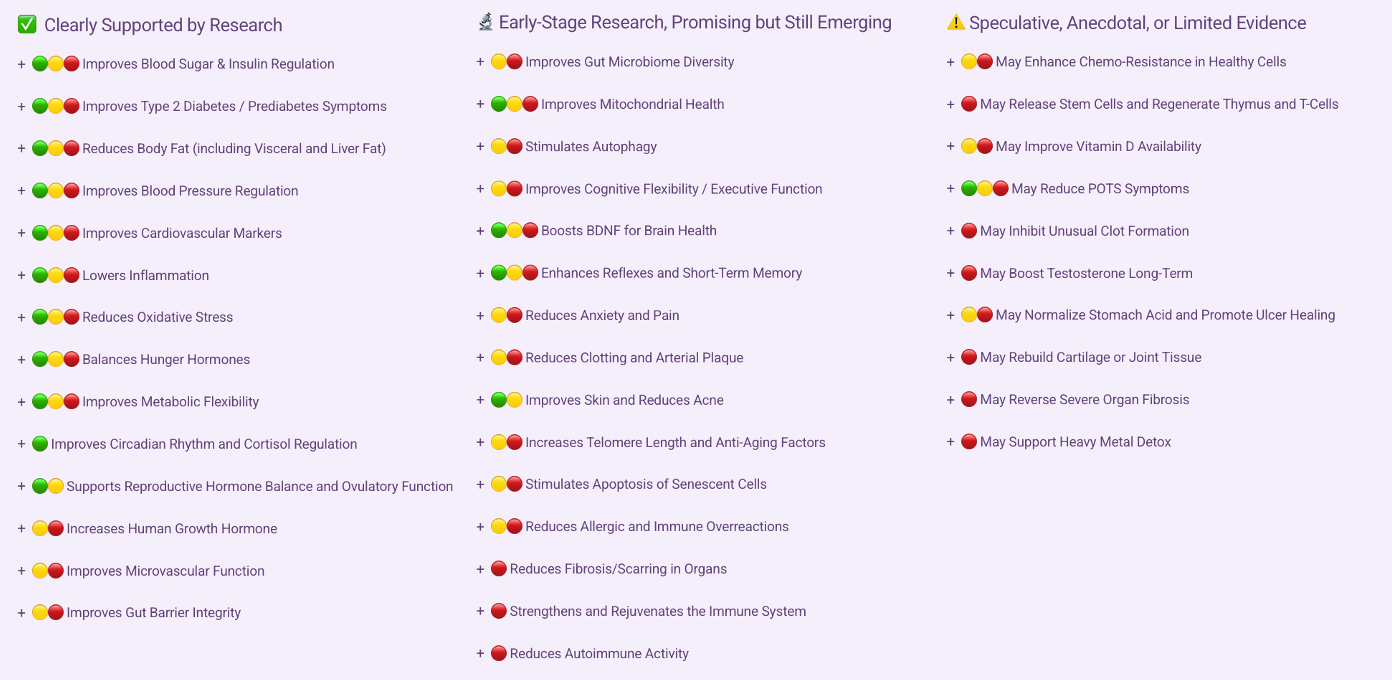
You can explore the complete categorized list of fasting benefits on the Fasting Benefits page.
⚙️ Whole-Body Benefits
The strongest fasting benefits are metabolic. Research consistently suggests fasting may improve blood sugar regulation, insulin sensitivity, body fat reduction, visceral and liver fat, blood pressure, inflammation, cardiovascular risk markers, and overall metabolic flexibility.
The core mechanism is relatively straightforward. Lower insulin levels shift the body away from energy storage and toward energy mobilization. Glycogen depletion pushes the body toward fat oxidation and ketone production. Reduced body fat and lower inflammatory signaling improve metabolic health further. This is where fasting is strongest scientifically and least controversial.
The graph below shows my own body composition changes during a 10-day water fast and the following 12-day refeed. Most of the lean tissue loss during fasting was restored during refeeding, while a significant portion of body fat remained reduced. You can find all of my fasting data, including body composition, blood sugar, ketones, cardiovascular markers, and other biomarkers, on the Results page.
🫀 System-Level Effects
Beyond metabolism, fasting appears to affect multiple body systems. In the brain and nervous system, fasting may improve cognitive flexibility, alertness, BDNF signaling, and mental clarity. Ketones are not just fuel - they also function as signaling molecules that may influence stress resistance and neuronal function, see a blog on fasting benefits for the brain “What Extended Fasting Does to Your Brain”.
In the gut and digestive system, fasting may improve gut barrier integrity, alter microbiome composition, and reduce digestive stress.
In the cardiovascular system, fasting may improve endothelial function, microvascular function, inflammatory signaling, and some cardiovascular risk markers.
In the hormonal system, fasting influences insulin, glucagon, hunger hormones, growth hormone, cortisol rhythm, and potentially reproductive hormone balance.
In the immune system, fasting may reduce immune overactivation and inflammatory signaling, while early-stage research suggests possible effects on immune regeneration and immune cell turnover.
This category is more uneven scientifically. Some effects are well-supported, while others remain early-stage or speculative.
🧬 Cellular Mechanisms
This is probably the most fascinating area of fasting research. During fasting, cells enter a lower-energy state that shifts the body away from growth and toward repair, recycling, and stress resistance. Nutrient-sensing pathways like mTOR become suppressed, while pathways like AMPK become more active.
Research suggests fasting may reduce oxidative stress, improve mitochondrial health, stimulate autophagy, activate longevity-associated pathways, and support removal of dysfunctional cells. I covered autophagy in more detail in my article on autophagy during fasting - “Autophagy During Fasting”.
At the same time, many of these effects remain difficult to measure directly in humans and are currently supported much more strongly by animal and mechanistic studies than by long-term human trials.
Some fasting claims online are clearly exaggerated though. Statements like “fasting fully resets the immune system” or “fasting significantly increases lifespan” go far beyond current human evidence.
✅ Final Takeaway
The strongest fasting benefits are metabolic - improved insulin regulation, reduced body fat, better blood sugar control, lower inflammation, and improved metabolic flexibility.
The most exciting fasting benefits are probably cellular - autophagy, mitochondrial adaptation, oxidative stress reduction, cellular repair pathways, and possible longevity-related mechanisms.
But the evidence is not equal across all claims. Some fasting effects, especially metabolic improvements like insulin sensitivity, body fat reduction, and blood sugar regulation, are strongly supported in humans. Others, particularly around autophagy, immune regeneration, and longevity, remain promising but much less certain.
You can explore the complete categorized fasting benefits list here - the Benefits page.
Fasting is a powerful health tool, but brings its own risks and downsides. Aggressive extended fasting may cause poor sleep, electrolyte imbalance, fatigue, muscle loss, hormonal disruption, and excessive stress on the body. Fasting works best when used intelligently as a metabolic tool, not as an extreme endurance challenge. If you are considering longer fasts, it is also important to understand the real fasting risks and downsides before pushing duration too aggressively - take a look at “Fasting Risks and Downsides” blog.